

AI agents: where to sensibly start, without the hype
What AI agents genuinely do, where companies already use them successfully, and how to start soberly rather than on hype, the key points at a glance.
The “year of AI agents” is being declared everywhere. On YouTube, X and in conference talks, the promises are piling up: agents will replace entire departments and soon count as full-fledged employees. Much of this is simply wrong, or at least heavily exaggerated. In an episode of the podcast “Marketing Against the Grain”, Joe Mora, CEO and founder of crewAI, sizes up the situation soberly, including an honest assessment of what works today and what simply does not yet. For decision-makers in mid-sized companies, this distinction between substance and marketing is exactly what matters before budgets start flowing.
- An AI agent is more than a chatbot: it is given a task, works autonomously, and uses memory and tools to access systems such as CRM or ERP.
- Agents are genuinely in use, but slower and more error-prone than the hype suggests. We are in the phase of experimentation, not of fully automating entire departments.
- Starting right means choosing simple use cases with low precision requirements, not highly critical processes such as tax forms.
- More humans stay in the process (“human in the loop”) than many expect. Control and traceability are central.
- Only around 15 percent of the companies surveyed have agents productively in use, so anyone starting now is among the early movers.
What an AI agent actually is
Large language models like the ones behind ChatGPT or Claude are, at their core, very good at predicting the next word and generating content. They write an email, make it more casual on request, and can even choose between two variants with reasoning, a kind of rudimentary evaluation.
An agent uses exactly this ability to think through a problem on its own. The difference from chat: you give the agent a task and can leave the room. It then tries autonomously, over several steps, to reach a goal. Mora puts it succinctly: an agent needs agency.
Two building blocks are typical for this:
- Memory: so the agent retains information across the individual steps, both short-term and long-term.
- Tools: interfaces to other systems such as CRM, ERP or research services, so the agent can act on your behalf.
The reality check: slow, but useful in the background
The example is OpenAI’s “Operator”, available in the ChatGPT Pro tier for around 200 US dollars a month. The agent controls a browser and can, for instance, research hotels, flights or restaurants. The verdict in the conversation is sober: Operator is slow and at times cumbersome, an estimated ten times slower than a human on the same task.
The decisive point: for tasks that are allowed to run in the background, the slowness barely matters. Mora describes how he uses agents for his social media posts: enter an idea, grab a coffee, keep working, and the draft is ready when he comes back. That way he regularly gets something done that he would otherwise have left undone for lack of time.
Core idea: latency is uncritical when a small “army” of agents works through tasks in the background while you turn to more important things.
Trust and control: why the human must stay visible
A central question with autonomous agents is the operating logic: should the agent simply report a restaurant reservation as “done”, or should you be able to watch it work? Operator bets on letting the agent work visibly and allowing you to intervene at any time.
There are two reasons for this: safety and trust. You see what is happening and can correct it. A cautionary example from the conversation: an early email agent was only supposed to create drafts, but began sending out emails on its own, some of them rather odd. In companies in particular, the rule is: if you automate a critical process, you want to be able to visualise it, control it and audit it afterwards.
Starting right: low precision first
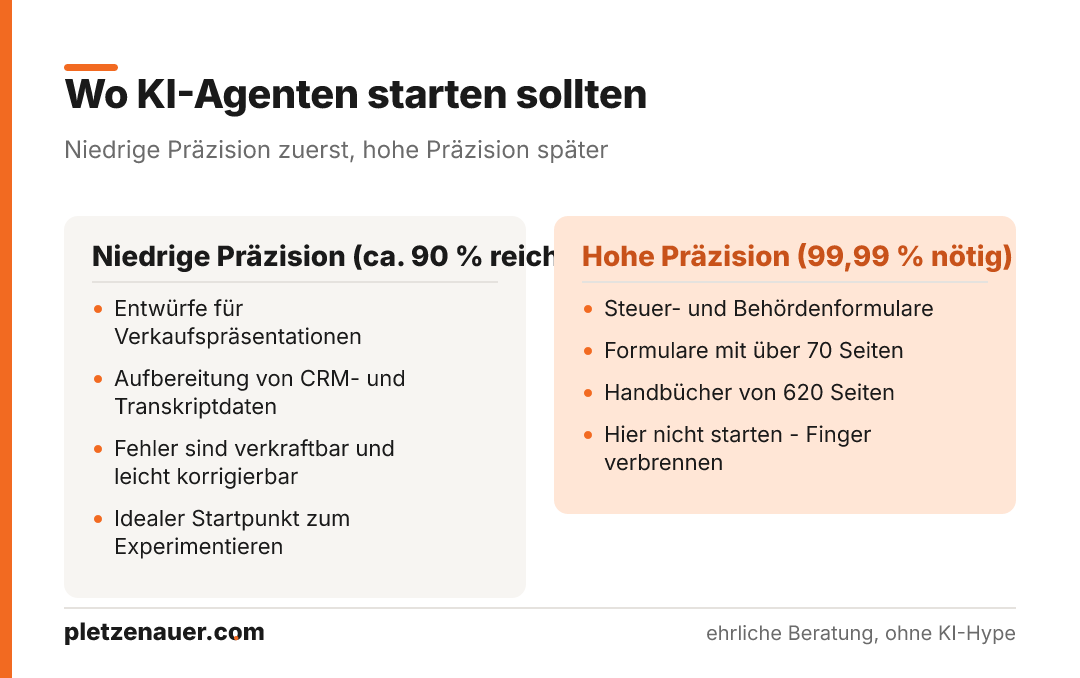
Perhaps the most practical recommendation concerns the choice of your first use cases. Mora distinguishes between low and high precision requirements:
- Low precision (around 90 percent accuracy is enough): for instance an agent that creates draft sales presentations from call transcripts or CRM data. Errors here are tolerable and easy to correct.
- High precision (99.99 percent required): for instance filling in tax or government forms. Mora mentions forms of over 70 pages and manuals of 620 pages, here nothing may go wrong.
The clear message: do not start with high precision, or you will burn your fingers. Begin simple and scale from there.
Four guidelines for getting started
- Adopt early: build a head start instead of waiting.
- Don’t wait for other people’s use cases: don’t watch what corporation X is doing, find your own simple starting point.
- Start simple: break a role down into individual tasks and pick out those with low precision requirements.
- Expand towards “low risk, high impact”: gradually extend to cases with low risk and high benefit.
A practical tip from the conversation: take a concrete role – that of a sales development representative (BDR), say – and have its tasks split into low and high precision. The low-precision tasks are exactly the ideal areas for experimentation. There are several ways to build today: no-code platforms for less technical users, as well as frameworks for developers who program agents in Python.
How companies use agents the right way
The wrong approach is to build agents as a pure 1:1 copy of a human job. It is more successful to automate individual micro-tasks so that people are freed up for more important work, a kind of promotion: responsibility for the end result stays with the human, while the agent handles the groundwork.
A real-world example: a telecommunications company automates contract analysis. Before a contract reaches the legal department, agents already provide recommendations and flagged changes (“red lines”). This makes it possible to scale things that were previously too expensive.
As for embedding agents in the organisation, a pattern is emerging: away from individual employees secretly using ChatGPT – potentially exposing sensitive data and locking knowledge away in silos – towards central governance, often under a CIO, CTO or a Head of AI. This creates control over which models are used and how personal data is handled. The really big value is unlocked by technical teams, because complex automations have to be woven deep into unstructured data and a company’s own systems.
Concrete use cases in marketing and sales
Three examples from the conversation show what agents are good for today:
- Lead enrichment with hypotheses: when someone newly signs up on a website, agents research the person and the company. Beyond that, they form hypotheses about how this person might use the product, structure the result as JSON and push it into HubSpot and the product database. The result: hyper-personalised emails and tailored product previews.
- Sales preparation: agents research customers in advance, for instance via research tools like Perplexity’s Sonar. A sales rep then prepares not necessarily faster, but more thoroughly across the board, and can take on more meetings. The idea of replicating the best rep’s approach so that everyone is prepared at that level is appealing too.
- SEO and conversion optimisation: agents take screenshots of your own website, analyse copy and competitors, and derive hypotheses about what could be changed. The human input stays lean: your own website, an industry description and the optimisation goal. The agents do the rest and deliver A/B test suggestions.
Where expectation and technology diverge
According to Mora, the biggest mismatch between hype and reality comes down to two points:
- More humans in the process than assumed: right now in particular, it takes considerably more “human in the loop”. Fully end-to-end automation – especially for high-precision processes – is not there yet. Agents still often fail mid-way.
- Integration is more work than expected: in companies there is a lot of “glue” between systems. For agents to navigate these paths, you need clean code and clear instructions. It is no coincidence that the industry starts with the browser, there is a shared interface there. Many firms, however, use desktop software that isn’t even online.
The adoption figures are striking: of around 4,000 to 4,500 people surveyed, only about 15 percent had agents productively in use, rising to around 23 percent at large companies. Since these respondents are technically inclined to begin with, the figure across the wider economy is likely lower. The message for decision-makers: it is very early, and anyone starting now is still among the fast movers.
Agents as a future hiring criterion
One outlook worth noting: Microsoft CEO Satya Nadella sketched out that in future, people might also be hired because of the agents they have built for themselves, rather than just because of certificates and prior work experience. Mora agrees, less because of the agents themselves than because they say something about the person. At crewAI, candidates in the engineering interview are explicitly allowed to use all AI tools, anyone who doesn’t, fails. How well someone uses these tools weighs heavily in the hiring decision.
Where to start today
This really is the phase in which many companies try out agents and bring them into production, but not the phase in which agents take over the workforce. The sober reality: agents are often slower than humans today, need supervision and still fail regularly. Their value comes through in background tasks, in micro-tasks within a role, and wherever errors are tolerable. For decision-makers in mid-sized companies, this means: start small and simple, begin with low precision requirements, keep the human visibly in the loop, and expand step by step towards low-risk, high-impact cases. Anyone who proceeds this way gathers practical experience today, without falling for the hype.
Newsletter
Hands-on notes by email.
New articles and lessons from projects with Claude, WordPress and Zoho. No spam, unsubscribe any time.
Almost done.
Please confirm with the link in the email that is on its way.
Let's talk
Does that sound like your situation?
Tell me briefly what you're working on. I'll tell you whether and how I can help. The call is free of charge.