
Andrej Karpathy – former head of AI at Tesla – explained at AISN 2026 why most people use AI the wrong way. Not because they practise too little, but because they misunderstand the tool. His method for working dramatically faster with AI breaks down into three layers: spec, verification and environment. Here is what is really behind it – no hype, but something you can put into practice.
The key points at a glance
- AI is brilliant at what is measurable, blind to context. It does not know your goal – that is on you to provide.
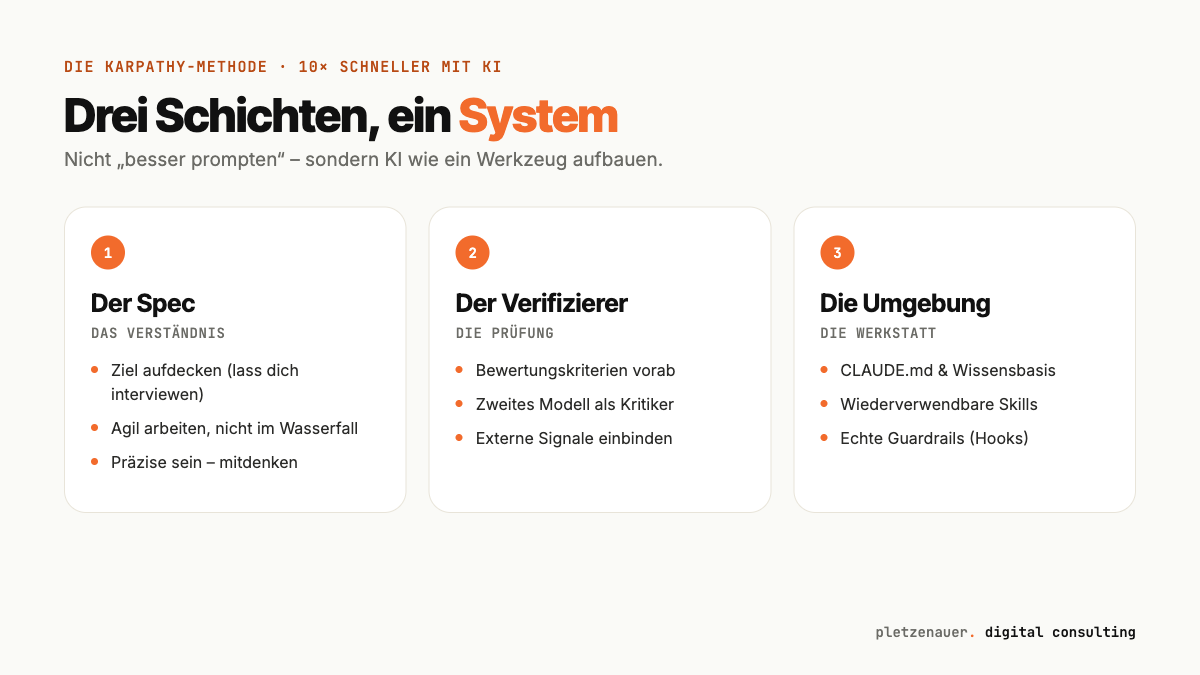
- Layer 1 – Spec: Clarify the goal first, then work in small steps (agile) and with precision.
- Layer 2 – Verification: Define evaluation criteria up front, use a second model as a critic, bring in external signals.
- Layer 3 – Environment: CLAUDE.md, your own knowledge base, reusable skills and real guardrails.
- The core: “You can outsource your thinking – but not your understanding.”
Why AI fails at simple questions
Karpathy gives a simple example: “I want to go to the car wash, it’s 50 metres away. Should I drive or walk?” Today’s leading models – Claude, Gemini, Grok, ChatGPT – all answer: walk, it’s so close. Wrong. Because to wash the car, you need the car there with you.
That is the whole point: AI is brilliant at anything that can be measured – and blind to anything that needs context. Your goal, your constraints, your gut feeling: AI has no signal for any of that. So the task is not to “prompt better”, but to close the gap between your understanding and AI’s computing power. That is exactly what the three layers do.
Layer 1: The spec – your understanding in usable form
A spec is how you hand your understanding to the AI – in a format it can actually work with. The well-known “plan mode” in Claude points in the right direction, but for Karpathy it is too shallow. His advice: design a genuinely detailed spec together with the AI tool. Here is how to do it in three steps.
1. Uncover the real goal
“Create a monthly report” is a task. The goal is the conclusion you draw, the decision the report triggers. The AI can never define the goal for you. Instead, let it interview you:
“Interview me to identify the goal of this project before you begin.”
2. Work agile, not waterfall
Most people throw everything at the AI at once (waterfall) and hope for the finished result. It is better to do agile speccing: tight scope, clear checkpoint, review the result, adjust, repeat. That way you notice early if the direction is off.
“Lean towards smaller, more tightly scoped specs with clear intermediate results.”
3. Be precise – and think along
The more precise you are, the less the AI has to assume. And every assumption is a chance to drift away from the result you wanted. When the AI writes a spec for you, read it critically – with your own head.
“Have me explicitly confirm key decisions so that nothing is overlooked.”
Three building blocks, one result: a tightly scoped, well-considered spec that fits your actual goal. Karpathy calls this modern engineering – a mindset that everyone working seriously with AI will need going forward.
Layer 2: The verifier – letting AI check its own work
The most frustrating thing about AI is checking the result. To understand why, Karpathy’s mental model helps. He talks about “animals” versus “ghosts”: people are like animals – with motives and emotions. If you tell someone “become an SEO pro in 14 days or you’re fired”, the person will find a way. AI works differently.
A more vivid image: think of the AI as a robot librarian. It answers questions only from the books in its library. If a book is missing, it cannot help – and often does not notice. That is why it shines at maths and stumbles on context: where there are clear answers in the library, it is brilliant; where there are not, it is confidently wrong. Shouting, pleading or “do better” does not help. The only real lever is verification. Three starting points:
- Define evaluation criteria up front. Instead of “make the report good”: “The report has three sections, each ending with a recommendation.” The more precise up front, the less room for error.
- A second model as a critic. A second librarian from a different library evaluates the first one’s result. In Claude Code you can use the Codex plugin, for example: “If this turns into a complex build, have Codex review the final result.”
- Bring in external signals. Connect the AI to the system that knows the truth – such as the deployment environment, to confirm that something was actually shipped. Or provide old reports as a reference format.
Boris Cherny, creator of Claude Code, puts it succinctly: if Claude has a feedback loop, that doubles or triples the quality of the final result.
“Outline the evaluation criteria you use to ensure a high-quality final result. Be precise. Where it makes sense, bring in a second model or external data for checking.”
Layer 3: The environment – the workshop floor everything stands on
Spec and verification need a place to live: the environment you build in. Think of a workshop – the spec is the blueprint on the wall, the verifier is the quality control at the door, and the environment is the workshop itself. The problem: most people build from scratch every time. Here is how to set up a workspace that gets better over time instead:
- A clean CLAUDE.md file. It is loaded automatically with every prompt – the first thing Claude reads. Example: “Before you build anything multi-step, add a verification plan.” That way checking is enforced, not optional.
- Your own knowledge base (LLM knowledge base). A folder system with your own data that the AI can search easily. Your data is your moat – this is where your intellectual property begins.
- Reusable skills. Rule of thumb: whatever you do repeatedly becomes a skill – a manual for a specific task. “The best way to find a leak in a hose is to run water through it.” The more you use skills, the better they get.
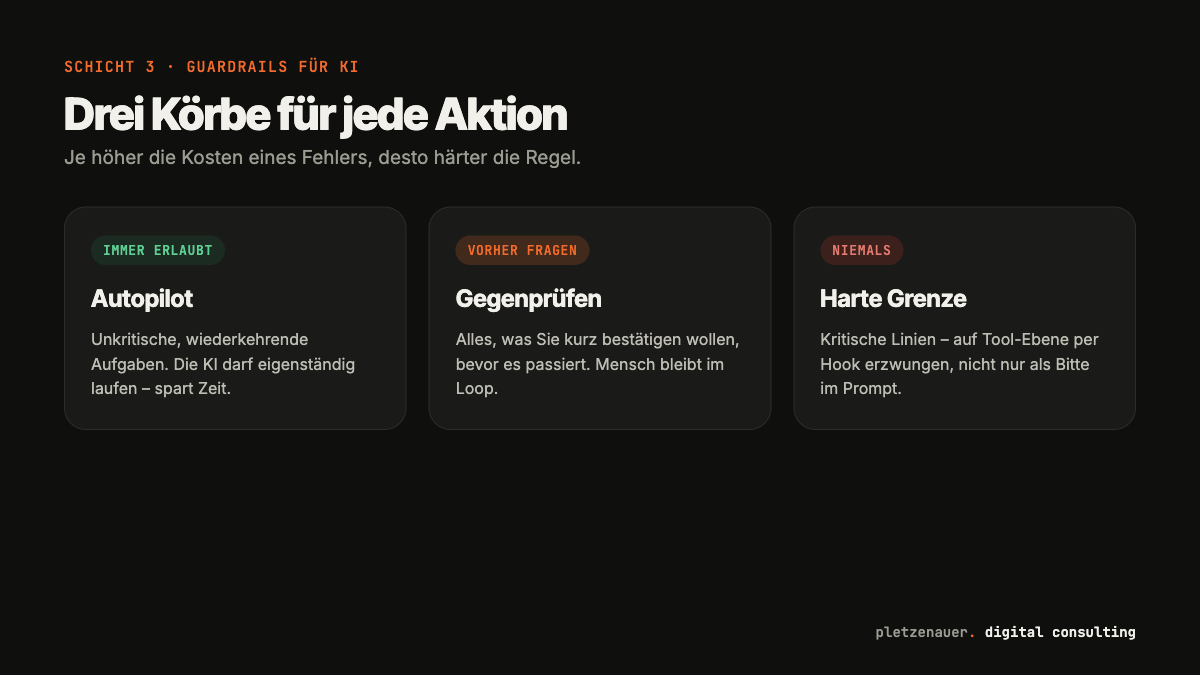
- Real rules instead of requests. A sentence in CLAUDE.md (“don’t make things up”) is a request the AI can ignore. Whatever is critical belongs enforced at the tool level – for example a pre-tool-use hook that hard-protects certain files.
Sort your actions into three buckets: always allowed (runs on autopilot), ask first (double-check) and never (limits that must not be crossed). Make the environment your world – the AI lives in it, not the other way around.
The one thing that matters
“You can outsource your thinking – but not your understanding.”
– Andrej Karpathy
All three layers revolve around exactly this: your understanding of the bigger picture. You have to know your goals and know what it takes to steer the AI in the right direction. Tools are getting cheaper – understanding stays scarce.
Conclusion
“Prompt better” is the wrong question. Anyone who really gets faster and better with AI builds a system: a precise spec that starts from the goal; verification that enforces quality; and an environment that grows with every use. This is not magic and not hype – it is clean work in which you keep your head. That is exactly how we advise, too: honest, measurable, without AI hype. If you want to set this up in your company, let’s talk.
Take it with you
The complete method as compact handouts – ideal to save and share with your team:
📄 Free download
The Karpathy method – guide (PDF)
📋 Free download
The Karpathy method – cheat sheet with prompts (PDF)
Source: “Stop Prompting Claude. Use Karpathy’s Method Instead.” by Austin Marchese (YouTube). Freely summarised and translated.