
Few terms come up as often in digitalisation conversations right now as n8n – usually in the same breath as “AI agents” and the prospect of automating entire areas of work. A lot gets promised: independently thinking agents that take over your processes. The reality is more sober and – for decision-makers in SMEs – far more useful once you separate three things that are often lumped together: automation, AI automation and AI agents.
This article sorts out the terms, shows where the real value lies, and explains why it is precisely the least spectacular variant that often turns out to be the most valuable in practice.
- n8n is not an AI tool, but an automation tool – some of the most valuable workflows work entirely without AI.
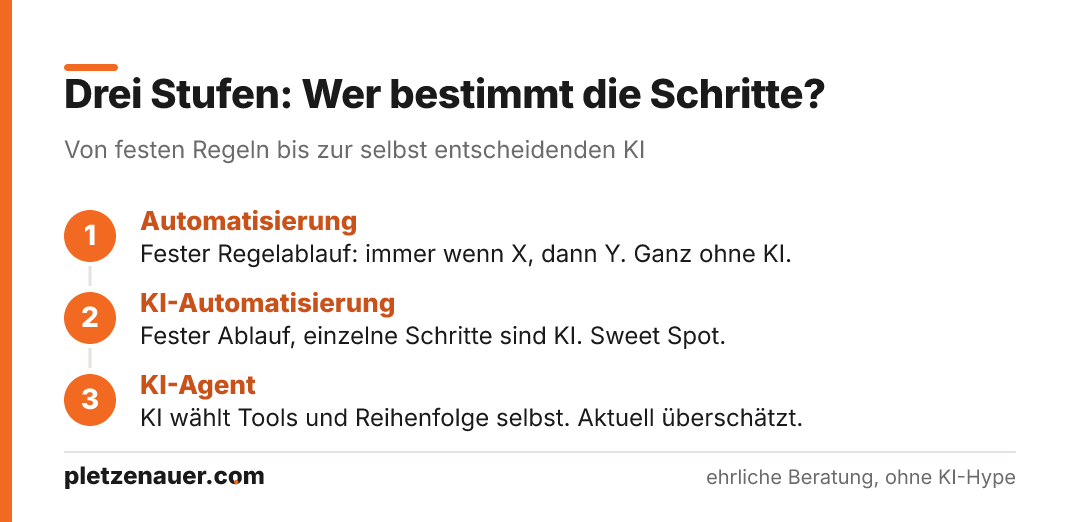
- Three terms, three concepts: automation (fixed rules), AI automation (AI as a fixed step in the workflow) and AI agents (AI decides the steps itself).
- AI agents are currently overrated: hallucinations and compounding error probabilities make them unreliable for many applications.
- The practical sweet spot is semi-automatic AI automation with a “human in the loop” – a person approves at the critical point.
- Self-hosting (e.g. your own server) lowers costs and gives full control over your data – a clear advantage over purely cloud-based tools.
Two developments that come together
Today’s AI agents are the end product of two parallel developments over the past few years.
1. Better language models
AI language models like ChatGPT are at their core nothing more than a statistical prediction of how a text might continue – a sophisticated version of the word suggestions you know from your smartphone. That explains an important property: the answers are not designed to be correct, but to sound plausible. By now these models can research live and connect to your own data sources such as Notion, calendars or spreadsheets.
2. Easier automation
Automation initially has nothing to do with AI. It is about linking systems according to firmly defined rules: someone pays on a website, receives the product by email, is added to the newsletter, and you get a notification. Thanks to low-code and no-code tools – Zapier, Make and, of course, n8n – such workflows can now be built without programming knowledge.
n8n has an advantage here that matters to businesses: it can be self-hosted. Instead of potentially hundreds of euros per month, you pay only a few euros for your own server – and keep full control over which data is shared with which application.
n8n is not synonymous with AI agents. Some of the most valuable automations are classic, rule-based processes following the pattern “whenever X, then Y”.
The three terms cleanly separated
From these two developments emerge three clearly distinguishable concepts:
| Term | Who decides the steps? | Example |
|---|---|---|
| Automation | Fixed rule-based sequence | New email received → notification on Telegram. |
| AI automation | Fixed sequence, individual steps are AI | New email → AI checks whether it is a login code → only then a Telegram message. |
| AI agent | The AI decides for itself | Input in, output out – the agent chooses tools and order on its own. |
An AI automation stays structured: trigger, then AI step, then branch, then action – always in that order. An AI agent, by contrast, receives only an input and a goal. It has a language model (the “brain”), a memory, a database and a set of tools – and decides for itself, based on its instructions, which tools it calls in which order. Agents can run through several loops and even use other agents as tools (“agent swarms”).
Why AI agents are currently overrated
The supposed advantage – not having to specify any structure – often turns out to be a disadvantage in practice. The reasons are concrete:
- Hallucinations are not solved. The language model remains the same statistical model that also confidently states falsehoods. A different name does not make it any smarter.
- Errors multiply. Even at a 90% hit rate per step, this adds up over many calls: with around ten AI steps, the error probability is already roughly 50%.
- Hard to recover. Once a multi-agent workflow heads in the wrong direction, it only gets back on course with difficulty – in the worst case it ends up in infinite loops repeating the same call.
- Hidden costs. Even with self-hosting, the credits for the AI providers (OpenAI, Claude, Google) still apply – loops get expensive.
A large part of the hype is explained not by usefulness but by other factors: the term “AI agent” sounds attractive, complex workflows look impressive, and the network effect of social media amplifies successful content. The “AI automation agency” business model also fuels the attention – a genuinely interesting niche, but no quick money: marketing and sales remain demanding.
When an AI agent makes sense
Agents are by no means useless – just overrated relative to the hype. As soon as significantly more reliable models appear, the picture can shift quickly. n8n users in particular then benefit, because they can simply swap out the underlying model. That is also an argument for not committing to a single AI provider.
As things stand today, an agent pays off above all in one constellation:
A use case that is conceptually simple but combinatorially complex – for example, a pure assistant that works exclusively with your email account. Here you can write a clear instruction and hand over a limited toolbox, without having to model out every possible sequence yourself.
The real sweet spot: semi-automatic AI automation
In almost all other cases, the biggest lever lies in semi-automatic AI automation. It saves considerable time without the risks of independently acting agents. Two proven patterns:
- Human starts, AI supports: you deliberately trigger a workflow (e.g. via a message in Slack), and the AI takes over sub-tasks such as research – faster, but under your control.
- Human in the loop: the workflow runs on its own but stops at the critical point and waits for human approval before continuing.
Tellingly: anyone who replaces several tasks with AI-supported workflows often gets by in practice with simple processes defined from left to right – entirely without an agent function. Had you instead built an agent that, say, writes texts on its own, hallucinations and false statements would have been inevitable. Simpler is often better.
Conclusion
n8n is rightly popular: automation is a timeless concept, and through self-hosting the tool lowers both costs and data risks at the same time. The hype around AI agents, by contrast, currently rests in part on the wrong reasons. For SMEs and mid-sized businesses this means: separate the terms, start with clear rule-based automations, add AI as a fixed step where it brings safe added value – and keep control at critical points via a “human in the loop”. AI agents have a future, but the reliable value today lies in unspectacular, well-thought-out automation.
Source: Was du über den n8n Hype wissen solltest – Niklas Steenfatt (YouTube)