
Many mid-sized companies face the same question when it comes to artificial intelligence: where do you actually start? That was exactly the focus of the first Rheinland Day in Siegburg, an event organised by Just Forward that brought together around 300 mid-sized businesses, researchers and young technology companies. The podcast “Markt und Mittelstand” spoke there with several guests – and the picture that emerges is pleasingly sober: less hype, more structure. We have summarised the practically usable insights for SME decision-makers.
- AI projects do not start with programming, but with understanding and a clear problem definition – only after that comes implementation.
- Before every project comes the work on the data basis: review, check, prepare. SMEs are often sitting on an underestimated trove of data.
- Instead of a pure proof of concept (POC), what counts is the proof of value: which problem is being solved, what benefit is created?
- Real-world use cases range from technical support to controlling robots to locally run models that keep company secrets in-house.
- In SMEs, AI often does not replace jobs but relieves overloaded specialists and secures knowledge that would be lost to retirement.
The starting point: strong research, weak translation into products
One of the day’s core observations concerns a structural weakness of the location. Germany has excellent research but does not succeed enough in turning its results into marketable products. Between research result and application, know-how is regularly lost – not infrequently foreign companies pick up the results and create the value there. The classic example remains the MP3 player.
Innovation activity in the country is declining, while worldwide it is above all technology companies that are gaining in value and importance – companies that emerge too rarely here and too rarely grow large enough. For SMEs, a concrete recommendation can be derived from this: innovation can be actively tapped from academia. Cooperation between industry and science was once stronger and has been declining for years. Even small companies can start here – in the case mentioned, a business with around 20 employees set up an endowed professorship at the local university.
How AI projects should start: three phases instead of a quick shot
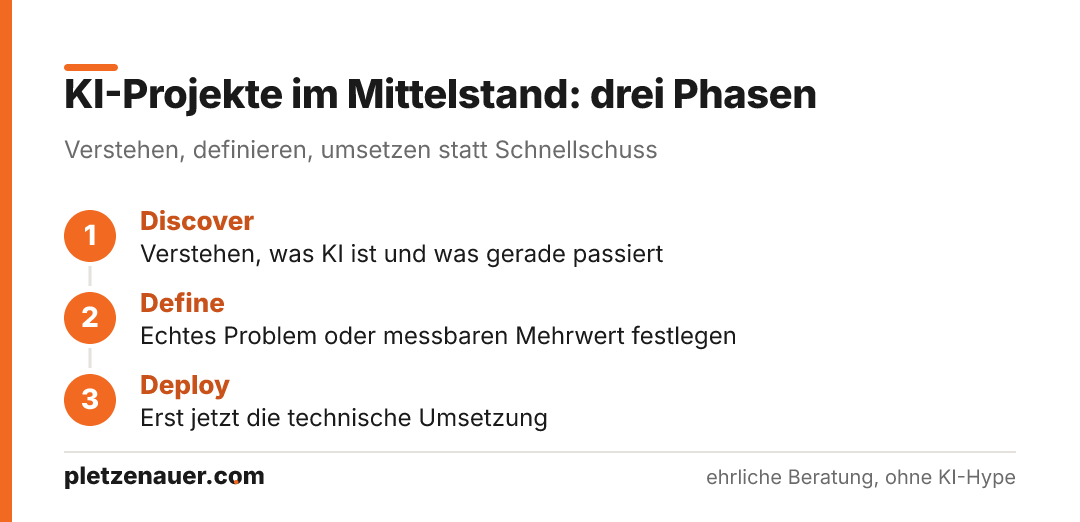
Perhaps the most useful contribution for everyday work is a simple approach. The most common mistake: companies begin directly with programming. That is the step that should come last. Instead, a three-phase process is recommended:
- Discover: make sure that managers and employees understand what AI even is and what is currently happening.
- Define: concretely define where AI solves a real problem or creates measurable added value – do not use AI just for the sake of using AI.
- Deploy: only now the technical implementation. That way you end up not with a “great solution” for its own sake, but with one that demonstrably brings benefit.
Data first, then the project
In addition, several interviewees stressed the importance of the data basis. Before you get started, an honest analysis is worthwhile: which data is available that you can build on? This review is best done with a data scientist. Only afterwards does it continue strategically – with the question of the right use cases, the vision and, above all, the proof of value.
The difference is decisive: many initiatives fizzle out because a proof of concept works technically, but no one checked whether it actually solves a real problem. The guiding questions before any investment are therefore: are we saving time? Are we becoming more efficient? What ROI does this bring? And which conditions – data protection included – must be taken into account?
Concrete use cases from SMEs
Abstract strategy helps little without examples. The following fields were presented at the event with a practical focus.
Technical support and knowledge preservation
For highly complex machinery, of which often only one unit exists, the documentation quickly runs to hundreds of thousands of pages. According to the accounts, specialists in after-sales support easily spend around 25 percent of their time just searching through these documents. AI-supported systems can deliver the right answer here immediately – provided the central risk is kept under control: hallucinations. An answer always sounds plausible but is sometimes simply wrong. In safety-relevant environments that is unacceptable, which is why the data must be prepared in a way that the language model can read reliably.
What is remarkable is the reaction of the specialists affected: in overloaded support teams there is practically no fear for jobs. On the contrary – AI closes the gap that arises when experienced employees retire with all their company knowledge and the skills shortage makes filling the role difficult. It is not about automating jobs but about keeping teams able to act.
AI and robotics in production
For many mid-sized companies, commissioning and reprogramming robots or machines from different manufacturers is a major hurdle – the necessary know-how is missing internally, and external integrators are expensive. Language models make a dialogue-based control possible here: machines can be set up without deep programming knowledge and robots controlled via foundation models.
Two points are central here. First, control: SMEs have little interest in camera images from their production flowing into the cloud or to US companies, because they contain trade secrets. Locally run systems address exactly this – including the traceability of which tasks are currently being solved and where things are stuck. Second, the data treasure: while US applications strongly target knowledge work, the bigger lever for German SMEs lies on the shop floor. Companies with a lot of background knowledge can feed models with it – an advantage that American providers do not have without this data.
Marketing: location data and geofencing
In marketing, geofencing was cited as an example. Locations are defined – for instance your own store or that of a competitor – in order to address the target group in a context-aware way. Anyone who spends 30 minutes to 2 hours at a competing car dealer is, with high probability, a purchase-ready prospect in the “lower funnel”. Similar logics apply to kitchen studios or the seasonal tyre change at car workshops. The prerequisite is manageable: not an extensive AI strategy paper, but clarity about the goal and the direct competition.
Voice-based AI agents for appointments and availability
Another example was telephone-based AI agents on a ready-made, GDPR-compliant platform, controlled via prompting and connected to an automation platform. Before, during and after a conversation, actions can be triggered – for example sending an SMS with the LinkedIn profile or arranging an appointment directly in the calendar. The practical value lies in scaling: such systems work around the clock, can handle many phone calls in parallel, and are suitable for restaurant reservations, hairdresser appointments or proactive reminders about the autumn tyre change.
Why personal exchange matters
For all the technology, one point was stressed several times: we are surrounded by artificial intelligence, yet real progress is ultimately created by human intelligence. The particular value of such events lies in the combination of two worlds – the decades of experience of established industrial companies and the more digital mindset of young tech startups. Deliberately, the Rheinland Day did not take place in a metropolis but where SMEs actually are: in the region.
Conclusion
The message of the Rheinland Day is pleasantly down-to-earth: AI in SMEs succeeds not through quick code, but through understanding, a clean data basis and clearly defined use cases with demonstrable benefit. Those who start with the proof of value rather than the pure proof of concept avoid the projects that fizzle out. The most convincing applications relieve specialists, secure valuable knowledge and keep sensitive data in-house. For SME decision-makers this means: the problem first, then the data, then the technology – in that order.
Source: KI-Lösungen für den Mittelstand – Markt und Mittelstand: Der Podcast (YouTube)